Zimbabwe
Prevalence rates
Child marriage by 15
Child marriage by 18
Interactive atlas of child marriage
Explore child marriage data in an interactive map view and layer data sets.
Other key stats
| Are there Girls Not Brides members? | 44 |
| Does this country have a national strategy or plan? | Yes |
| Is there a Girls Not Brides National Partnership or coalition? | Yes |
| Age of marriage without consent or exceptions taken into account | Legal age of marriage - 18 years or above, no exceptions |
What's the prevalence rate?
34% of girls in Zimbabwe marry before the age of 18 and 5% marry before the age of 15.
2% of boys in Zimbabwe marry before the age of 18.
Child marriage is more common in rural areas of Zimbabwe. Available data from the 2014 MICS indicate that 40% of women aged 20-24 living in rural areas, compared to 19% in urban areas, were married or in a union before the age of 18.
The provinces of Mashonaland Central and Mashonaland West have the lowest median ages of marriage.
The highest rates of child marriage are found in Mashonaland Central (50%), Mashonaland (42%), Mashonaland East (38%), Manicaland (36%), Masvingo (35%) and Midlands (30%).
What drives child marriage in Zimbabwe?
Child marriage is driven by gender inequality and the belief that girls are somehow inferior to boys. In Zimbabwe, child marriage is also exacerbated by:
● Poverty: Daughters are sometimes married to reduce their perceived economic burden, with their bride price (lobola) used by families as a means of survival. 50% of girls married before the age of 18 are from the poorest households in comparison to 14% of girls from the richest households.
● Level of education: Girls from Zimbabwe’s poorest households are more likely to marry before the age of 18 than girls living in the richest households. Many girls drop out of school because their parents cannot afford to pay school fees, which in turn puts girls at a higher risk of being married. 66% of girls married before the age of 18 had no or pre-primary education, 57% had primary education and 5% had completed higher education.
● Religion: Members of the indigenous apostolic church reportedly encourage girls as young as ten to marry much older men for “spiritual guidance”. Men in this church are reportedly entitled to marry girls to shield them from pre-marital sex, with girls becoming second or third wives in a polygamous marriage. Child marriage is prevalent in the Apostolic sect (42%), Zion (34%), Traditional (43%) and Pentecostal (21%).
● Family honour: If a girl engages in pre-marital sex, is seen with a boyfriend or returns home late, she is sometimes forced to marry to mitigate the shame. Some girls who fall pregnant choose to enter customary marriages because they are afraid their family will abuse them for dishonourable behaviour.
● Harmful practices: Virginity testing is still practiced in parts of Zimbabwe by the apostolic church. Girls who are found to no longer be virgins are shamed into wearing a mark on their forehead and are required to find another virgin for their husband to marry as compensation.
What international, regional and national commitments has Zimbabwe made?
Zimbabwe has committed to ending child, early and forced marriage by 2030 in line with target 5.3 of the Sustainable Development Goals.
During its Voluntary National Review at the 2017 High Level Political Forum, the government reaffirmed commitment to this target, highlighting that the Constitutional Court outlawed the marriage of people under 18 in 2016.
The government submitted a Voluntary National Review at the 2021 High Level Political Forum. In this report, the government highlighted that it has been engaging with faith-based organizations and traditional leaders to raise awareness on the constitutional provisions to end child marriage. Traditional leaders have come up with their own declarations on ending child marriage in which they commit to take the lead in ending child marriage in Zimbabwe.
The government has not submitted a Voluntary National Review in any High Level Political Forum since 2021.
Zimbabwe co-sponsored the 2017 Human Rights Council resolution recognising the need to address child, early and forced marriage in humanitarian contexts.
Zimbabwe co-sponsored the 2018, 2020 and 2022 UN General Assembly resolutions on child, early and forced marriage.
In 2014 Zimbabwe signed a joint statement at the Human Rights Council calling for a resolution on child marriage.
Zimbabwe ratified the Convention on the Rights of the Child in 1990, which the Committee on the Rights of the Child has interpreted to recommend the establishment of a minimum age of marriage of 18, and acceded to the Convention on the Elimination of All Forms of Discrimination Against Women (CEDAW) in 1991, which obligates states to ensure free and full consent to marriage.
In 2016 the UN Committee on the Rights of the Child urged Zimbabwe to establish an effective monitoring system to assess progress towards ending child marriage. It also recommended the government provide survivors with compensation and rehabilitation and conduct an investigation into the alleged involvement of members of religious sects in facilitating child marriage.
During its 2020 review, the CEDAW Committee recommended that the government raise the legal minimum age of marriage in line with the Constitution and the Convention on the Rights of the Child. The Committee also recommended that the government engage with community and religious leaders, parents and girls on the impact of child marriage.
During its 2021 Universal Periodic Review, the Government of Zimbabwe reported that the Inter-Ministerial Committee on Human Rights and International Humanitarian Law (IMC) have conducted human rights trainings for the Justice of Law and Order Sector (JLOS) members on child marriage. The government raised that despite their efforts to end child marriage, a few challenges still exist such as lack of cooperation from family members, especially when a bride price was promised, ignorance of the law, and religion.
During its 2016 Universal Periodic Review, Zimbabwe supported recommendations to address the exclusion of women in the economic, social and political sphere, with specific attention to child marriage.
In 2015 Zimbabwe launched the African Union Campaign to End Child Marriage in Africa and developed a National Action Plan and Communication Strategy.
In 1995 Zimbabwe ratified the African Charter on the Rights and Welfare of the Child, including Article 21 regarding the prohibition of child marriage. In 2008 Zimbabwe ratified the Protocol to the African Charter on Human and People’s Rights on the Rights of Women in Africa, including Article 6 which sets the minimum age for marriage as 18.
Zambia is one of 20 countries which committed to ending child marriage by the end of 2020 under the Ministerial Commitment on comprehensive sexuality education and sexual and reproductive health services for adolescents and young people in Eastern and Southern Africa.
In 2019, at the Nairobi Summit on ICPD25, Zimbabwe committed to end sexual and gender-based violence by 2030, including child marriage, by implementing the National Plan of Action on Ending Child Marriages, harmonise marriage laws and set the age of marriage at 18 years, invest in services for survivors, and economically and socially empower women and girls.
Zimbabwe is one of the countries where the Spotlight Initiative (a global, multi-year partnership between European Union and United Nations) is supporting efforts to end all forms of sexual and gender-based violence and harmful practices against women and girls. Between 2019-2020 the European Union invested $30 million USD. The funds were distributed as follows:
Policy: Assess gaps in implementation in order to draft and improve legislation on ending violence against women and girls; harmonize and align marriage laws; review criminal legislation on rape and sexual offences to ensure effective prosecution.
Institution: Enable the Ministry of Home Affairs and Ministry of Justice to develop and deliver evidence-based programmes that prevent and respond to violence against women and girls; enhance technical experts to plan gender-responsive budgeting.
Prevention: Develop evidence-based programmes and campaigns to promote gender-equitable norms, attitudes and behaviours by establishing comprehensive sexuality education in schools; develop advocacy platform to address sexual and gender-based violence and harmful practices.
Data: Strengthen technical capacities of government, civil society organizations, and statistics officers to collect qualitative data on violence against women and girls in order to strengthen the National Sexual and Gender-Based Violence management system to develop a framework and implementation plan.
Women’s movement and civil society: Engage with women’s rights groups to effectively influence and advance progress on gender equality and violence against women.
Since the implementation of the Spotlight Initiative, the achievements have been:
The launch of the High Level Political Compact on ending Gender Based Violence Harmful Practices (2021-2030).
The launch of the Strategy for the Elimination of Sexual Harassment and Gender-Based Violence in the workplace (2021-2025).
Increased supplies and equipment for the Zimbabwe Republic Police Force, to improve the collection and analysis of forensic evidence in sexual assault cases.
Increased access to sexual and gender-based violence services such as legal services and safe houses.
Increased awareness and reporting of gender-based violence at the community level.
Zimbabwe is one of the countries where the U.S. President’s Emergency Plan for AIDS Relief (PEPFAR)/DREAMS Initiative is working to reduce rates of HIV among adolescent girls and young women.
Zimbabwe is a partner country of the Global Partnership for Education (GPE).
What is the government doing to address child marriage?
In 2021, the Zimbabwe Human Rights Council, in partnership with civil society organizations such as the Zimbabwe Lawyers for Human Rights (ZLHR) and the Counselling Services Unit, launched mobile human rights clinics (MHRC’s). The main aim of these clinics is to raise awareness on topics such as child marriage, and provide free legal advice on information relating to the report, enforcement and remedies of child marriage. In Mashonaland West Province, community members expressed that despite knowing the laws surrounding child marriage, local law enforcement authorities did not take reported cases of child marriage seriously. Community members expressed that there was no political will to combat child marriage.
In 2021, 2,279 women’s groups were funded through the Women’s Development Fund and the Zimbabwe Library Association with a loan amount of $4,281,107 ZW to head programmes to educate the girl child. Free and accessible information on child marriage, rape and domestic violence was made available for those living in rural areas.
In December 2018, the First Lady of Zimbabwe launched the National Action Plan (NAP) and Communication Strategy on Ending Child Marriage. With a multi-sectoral approach coordinated by the Ministry of Women Affairs, the key objectives of the NAP are:
● Reduce the incidence of child marriage by addressing the root causes, including gender discrimination and school retention.
● Support girls in marriages or at risk of child marriage.
● Promote child and youth-led initiatives.
● Advocate for policy and legal amendments, including harmonisation of customary laws.
● Enhance evidence-based programming through collection of data.
The accompanying Communication Strategy aims at transforming social norms and behaviours around child marriage and mobilising media platforms to change gender norms.
Zimbabwe’s National Gender Policy was revised in 2017 and now includes components on addressing child marriage.
Previously, the government of Zimbabwe had also initiated a Life Skills, Sexuality, HIV and AIDS Education Strategy to address girls dropping out of school due to early marriages. This strategy seeks to empower learners and develop positive life skills.
What is the minimum legal framework around marriage?
In 2016 Zimbabwe’s Constitutional Court outlawed child marriage in accordance with the constitutional definition of “child” and the right to equal treatment. As a result, no one before the age of 18 may enter into marriage, without exception.
The ruling includes marriages under the Customary Marriages Act which had previously not had a minimum age requirement.
National Partnerships and Coalitions in Zimbabwe
In this country we have a national partnership. Many Girls Not Brides member organisations have come together to accelerate progress to end child marriage in their countries by forming National Partnerships and coalitions. Below is an overview of what and where these networks are, what they do and how they work with Girls Not Brides.
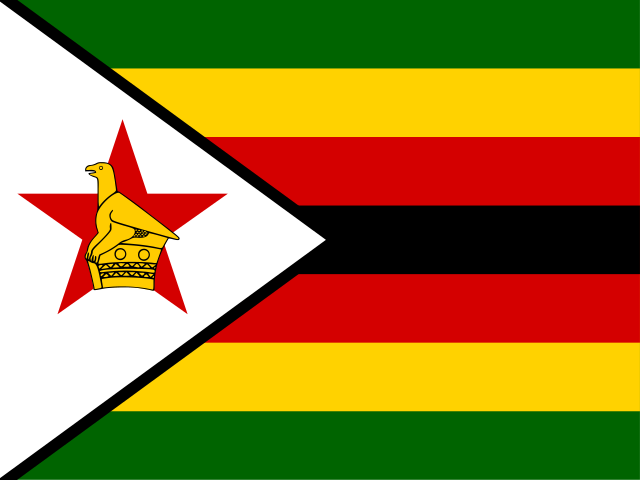
Content featuring Zimbabwe
Coping with Compound Crises: What Does This Mean for Child Marriage Interventions?
Joint Statement on Defending Girls’ Rights on Ending Child Marriage in the SADC Region
Reviewing progress on the SADC Model Law to end child marriage across 16 countries
Zimbabwe urged to deliver justice for Memory Machaya
Data sources
- African Commission on Human and People’s Rights, African Charter on the Rights and Welfare of the Child, [website], 2018, https://au.int/en/treaties/african-charter-rights-and-welfare-child (accessed January 2022).
- African Commission on Human and People’s Rights, Protocol to the African Charter on Human and Peoples' Rights on the Rights of Women in Africa, [website], 2018, https://au.int/en/treaties/protocol-african-charter-human-and-peoples-rights-rights-women-africa (accessed January 2022).
- African Union, Campaign to End Child Marriage in Africa: Call to Action, 2013, https://au.int/sites/default/files/pages/32905-file-campaign_to_end_child_marriage_in_africa_call_for_action-_english.pdf (accessed September 2024).
- Delegation of the European Union to Zimbabwe, Spotlight Initiative, [website], https://www.eeas.europa.eu/delegations/zimbabwe/spotlight-initiative_en?s=129 (accessed February 2024).
- Girls Not Brides, Zimbabwe: former child brides win case to make child marriages illegal, [website], 2016, https://www.girlsnotbrides.org/zimbabwe-former-child-brides-win-case-to-make-child-marriage-illegal/ (accessed January 2022).
- Global Partnership for Education, Zimbabwe, [website], https://www.globalpartnership.org/where-we-work/zimbabwe (accessed January 2022).
- Government of Zimbabwe, Zimbabwe Voluntary National Review (VNR) of SDGs For the High-Level Political Forum, 2017, https://sustainabledevelopment.un.org/content/documents/15866Zimbabwe.pdf (accessed January 2022).
- Government of Zimbabwe, Zimbabwe’s Second Voluntary National Review 2021, https://sustainabledevelopment.un.org/content/documents/279562021_VNR_Report_Zimbabwe.pdf (accessed February 2024).
- Government of Zimbabwe, Zimbabwe’s second voluntary national review 2021, 2021, https://sustainabledevelopment.un.org/content/documents/279562021_VNR_Report_Zimbabwe.pdf (accessed May 2022).
- https://au.int/sites/default/files/pages/32905-file-campaign_to_end_child_marriage_in_africa_call_for_action-_english.pdf (accessed January 2022).
- Human Rights Watch, Zimbabwe: Scourge of Child Marriage, [website], 2015, https://www.hrw.org/news/2015/11/25/zimbabwe-scourge-child-marriage (accessed January 2022).
- Ministerial Commitment on comprehensive sexuality education and sexual and reproductive health services for adolescents and young people in Eastern and Southern African, [website], 2014, https://www.youngpeopletoday.org/esa-commitment/ (accessed January 2022).
- Ministry of Foreign Affairs of Denmark, Joint statement on child, early and forced marriage, HRC 27, Agenda Item 3, [website], 2014, http://fngeneve.um.dk/en/aboutus/statements/newsdisplaypage/?newsid=6371ad93-8fb0-4c35-b186-820fa996d379 (accessed January 2022).
- Ministry of Women Affairs, Community, Small and Medium Enterprises Development, Zimbabwe National Action Plan and Communication Strategy on Ending Child Marriage, 2018, https://zgc.co.zw/wp-content/uploads/2022/10/Zimbabwe-National-Action-Plan-on-Ending-Child-Marriage-1.pdf (accessed January 2022).
- Nairobi Summit, Zimbabwe committing ending sexual and gender based violence, [website], 2019, http://www.nairobisummiticpd.org/commitment/zimbabwe-commiting-ending-sexual-and-gender-based-violence (accessed January 2022).
- Spotlight Initiative, Zimbabwe, [website],https://spotlightinitiative.org/zimbabwe (accessed January 2022).
- Spotlight Initiative, Zimbabwe spotlight country programme, https://mptf.undp.org/factsheet/project/00111645 (accessed May 2022).
- The Herald, First Lady in drive to end child marriages, [website], 2018, https://www.herald.co.zw/first-lady-in-drive-to-end-child-marriages/ (accessed January 2022).
- The Zimbabwean, Give us books not husbands,[website], 2014, http://www.thezimbabwean.co/2014/08/give-us-books-not-husbands/ (accessed January 2022).
- The Zimbabwean, ROOTS launches ‘Not Ripe for Marriage’ campaign, [website], 2014, http://www.thezimbabwean.co/2014/08/roots-launches-not-ripe-for/ (accessed January 2022).
- U.S. Department of State, United States President’s Emergency Plan for AIDS Relief, [website], 2019, https://www.state.gov/where-we-work-pepfar/ (accessed January 2022).
- UN CEDAW, Sixth periodic report submitted by Zimbabwe under article 18 of the Convention, CEDAW/C/ZWE/6, 2019, https://tbinternet.ohchr.org/_layouts/15/treatybodyexternal/Download.aspx?symbolno=CEDAW%2fC%2fZWE%2f6&Lang=en (accessed January 2022).
- UN CEDAW, Concluding observations on the sixth periodic report of Zimbabwe, 2020, https://docstore.ohchr.org/SelfServices/FilesHandler.ashx?enc=6QkG1d%2fPPRiCAqhKb7yhsjRQNw4j9iQmKc34zuC413ui2Qg7oSkBwxT%2b4jqPnttF2eBvoWt7aMs0vDHGrUdoNYI6k0gUIdib%2bsVbdKgJtqomj2YAD%2fsdCF0yg7sQTn6I (accessed May 2022).
- UN Committee on the Rights of the Child, Concluding observations on the second periodic report of Zimbabwe, 2016, p.11, http://tbinternet.ohchr.org/_layouts/treatybodyexternal/Download.aspx?symbolno=CRC/C/ZWE/CO/2&Lang=En (accessed January 2022).
- UN General Assembly, Report of the Working Group on the Universal Periodic Review: Zimbabwe, 2016, p.16, http://www.ohchr.org/EN/HRBodies/UPR/Pages/ZWIndex.aspx (accessed January 2022).
- UN General Assembly, National report submitted in accordance with paragraph 5 of the annex to human rights council resolution 16/21• Zimbabwe, 2021, https://documents-dds-ny.un.org/doc/UNDOC/GEN/G21/320/41/PDF/G2132041.pdf?OpenElement (accessed May 2022).
- UNDP Zimbabwe, New National Gender Policy is Launched, [website], 2017, http://www.zw.undp.org/content/zimbabwe/en/home/presscenter/articles/2017/07/06/milestone-as-new-national-gender-policy-is-launched0.html (accessed January 2022).
- United Nations, Sustainable Development Knowledge Platform, [website], 2017, https://sustainabledevelopment.un.org/sdg5 (accessed January 2022).
- Zimbabwe National Statistics Agency (ZIMSTAT), Multiple Indicator Cluster Survey 2014, Key Findings, 2014, https://reliefweb.int/report/zimbabwe/zimbabwe-multiple-indicator-cluster-survey-2014 (accessed January 2022).
- Zimbabwe National Statistics Agency, Multiple indicator cluster survey 2019 survey findings report, 2019, https://mics-surveys-prod.s3.amazonaws.com/MICS6/Eastern%20and%20Southern%20Africa/Zimbabwe/2019/Survey%20findings/Zimbabwe%202019%20MICS%20Survey%20Findings%20Report-31012020_English.pdf (accessed May 2022).
- Zimbabwe Multiple Indicator Cluster Survey 2019, https://www.unicef.org/zimbabwe/media/2536/file/Zimbabwe%202019%20MICS%20Survey%20Findings%20Report-31012020_English.pdf (accessed September 2022).
- Zimbabwe Human Rights Commission, Annual Report 2021, https://www.zhrc.org.zw/wp-content/uploads/2022/09/2021-ZHRC-Annual-Report.pdf (accessed February 2024).